


After the Baby: Your Family, My Family and Us
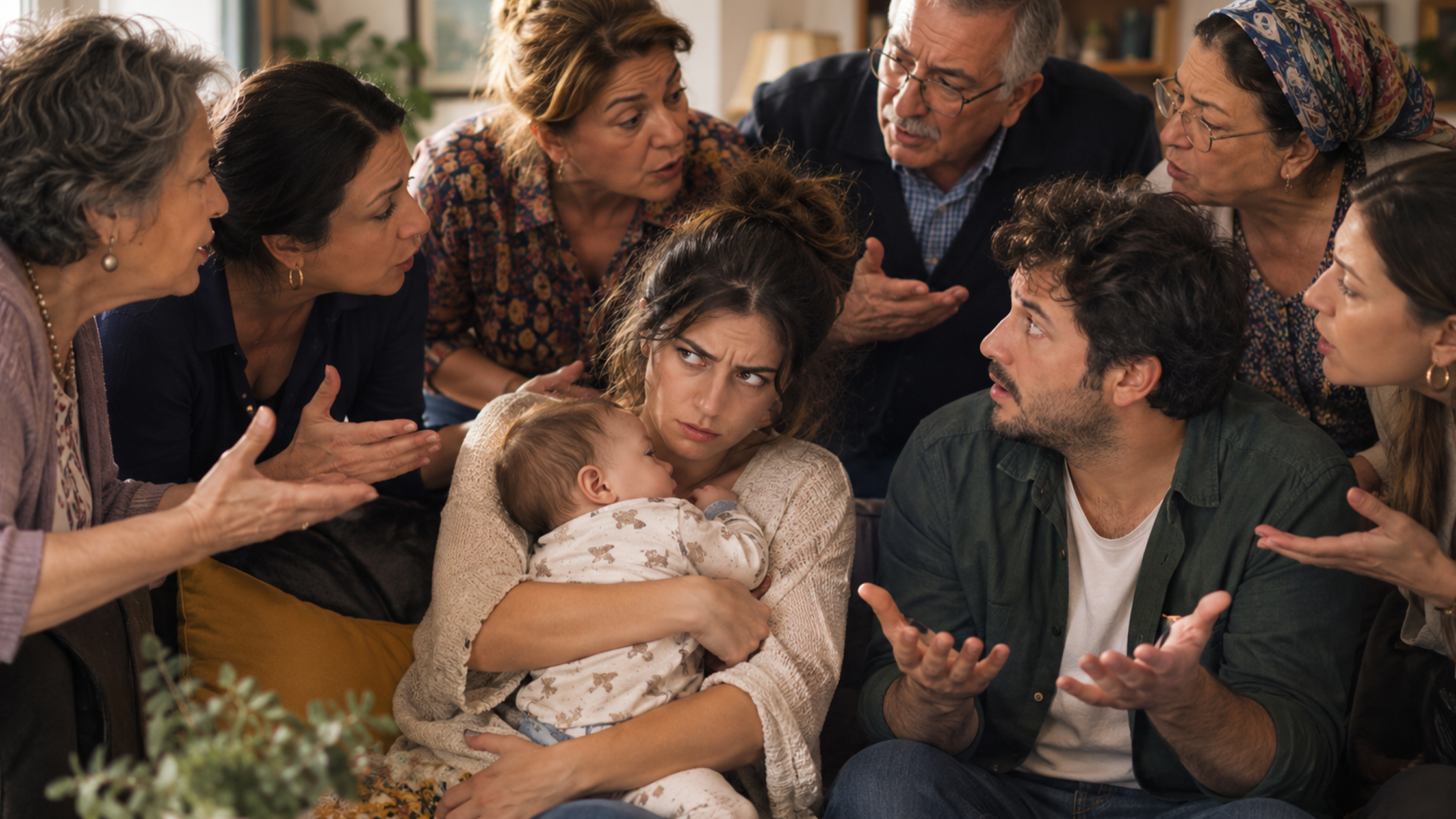
The arrival of a baby is usually described as one of the happiest moments in a couple’s life. And from the outside, it often looks exactly like that: a newborn baby, excited parents and grandparents surrounding them with love and offers of help.
But a baby is not the only thing that arrives after birth.
Grandparents arrive. Advice arrives. “This is how we did it” arrives. “You are holding the baby wrong.” “The baby must be hungry.” “You are picking them up too much.” “Go and rest, I’ll do it.”
And suddenly a question that the couple may never have needed to answer before becomes very important:
Who decides the boundaries of this new family?
This is something I find particularly interesting when working with couples after they become parents.
And I do not think it belongs to one particular culture.
We can see surprisingly similar dynamics in couples from completely different backgrounds. It may be a Brazilian woman and her British husband, a Turkish person and their East Asian partner, or two people who have both grown up in Turkey.
The details are different.
The emotions underneath can be remarkably similar.
One partner says, “Does your mother really need to be here every day?”
The other hears: “You don’t like my mother.”
In another relationship, someone asks, “Why does every decision about our baby have to be discussed with your mum first?”
Their partner hears: “You are trying to separate me from my family.”
A new mother may be trying to settle her baby while her mother-in-law repeatedly steps in to show her a “better” way.
Perhaps what she actually wants from her partner is one simple sentence:
“Mum, let us try.”
But her partner says nothing.
Later that evening, they argue.
On the surface, the argument is about the mother-in-law.
Emotionally, it may be about something very different:
“You left me alone in that moment.”
This, for me, is where many postnatal conflicts involving extended family become much more interesting.
Because the question is often not who knows more about babies.
The deeper questions are about loyalty, boundaries and priority.
Becoming parents requires a major shift in a couple’s relationship. They are no longer only partners or lovers. They also have to become a team.
And this can expose a difficult question:
Am I still primarily my parents’ child, or am I now an adult member of the family I have created?
Of course, we can be both.
The difficulty begins when those two roles collide.
If your partner says, “I don’t want your mother coming over every day,” and you experience that as an attack on your mother, the conversation is no longer simply about childcare.
It may have touched loyalty, guilt and patterns that began long before your partner was in your life.
Equally, if your partner needs their mother constantly after giving birth and you gradually begin to feel like a guest in your own home, your argument may sound like:
“When is your mum going home?”
But underneath, you may actually be asking:
“Where is my place in this new family?”
These are not small questions.
And the postnatal period is already demanding enough.
There is sleep deprivation.
Exhaustion.
Feeding difficulties.
A changing body.
Changes in sex and intimacy.
Returning to work.
Arguments about who slept more.
Who is more tired.
Who gets up during the night.
Who carries the mental load.
And sometimes the painful feeling that one person’s life has changed completely while the other person’s life appears to have changed much less.
Add extended-family expectations to all of this and a seemingly tiny incident can carry enormous emotional weight.
“Your mother took the baby out without asking me.”
“Your father told us again how we should raise our child.”
“You become a completely different person when your family is here.”
“You look unhappy whenever my family visits, but yours can come whenever they want.”
“Why didn’t you say anything when your mother criticised me?”
These statements may sound like complaints.
But underneath them there may be much more vulnerable questions:
Do you see me?
Are you on my side?
Do I have a voice in my own home?
Am I still important to you?
Are we actually a team?
One of the biggest traps couples can fall into is turning the conversation into a competition about whose family is more difficult.
At that point, both partners become lawyers for their own families.
“Your mother did this…”
“Well, your father always…”
“At least my family helps us.”
“What would we do without my mum?”
And eventually the couple stops listening to each other and starts defending two different family systems.
But perhaps the real problem is not either family.
Perhaps it is the boundary the couple has not yet created between them.
And there is something I think we need to be a little bolder about here.
When an adult repeatedly expects their partner to set boundaries with their family for them, they may be placing their partner in an almost impossible position.
“Just tell my mum yourself” might sound practical.
But often it is healthier for each partner to take responsibility for communicating boundaries to their own family.
Setting a boundary does not mean rejecting your parents.
“We would like some time alone today” does not mean “We don’t love you.”
“We want to make this decision about our baby ourselves” does not mean disrespect.
And accepting help does not mean giving somebody else control over your new family.
Perhaps one of the most important conversations couples need after having a baby is not about the colour of the nursery or which pushchair to buy.
It is this:
What are the boundaries around our new family?
How involved do we want our families to be?
Are unannounced visits okay?
Who makes the final decisions about our child?
If one family member crosses a boundary, who speaks to them?
How do we ask for help without giving away our autonomy?
And perhaps most importantly:
How will we protect each other when we are with our own families?
Cultures differ. Languages differ. Expectations around parenting and grandparents differ enormously.
Yet in the therapy room, a Brazilian woman with a British husband, a Turkish person with an East Asian partner and two Turkish partners may eventually be trying to communicate something remarkably similar:
“I am not asking you to remove your family from your life. I am asking you to protect my place in the family we created together.”
Perhaps that is the real issue.
When a baby is born, it is not only a child who enters the world.
A new family is born too.
And sometimes one of the first things that new family needs to learn is not how to close the door to everyone else, but how to decide together who holds the key.
